Planning the cities of the future
By Madeline Marriott
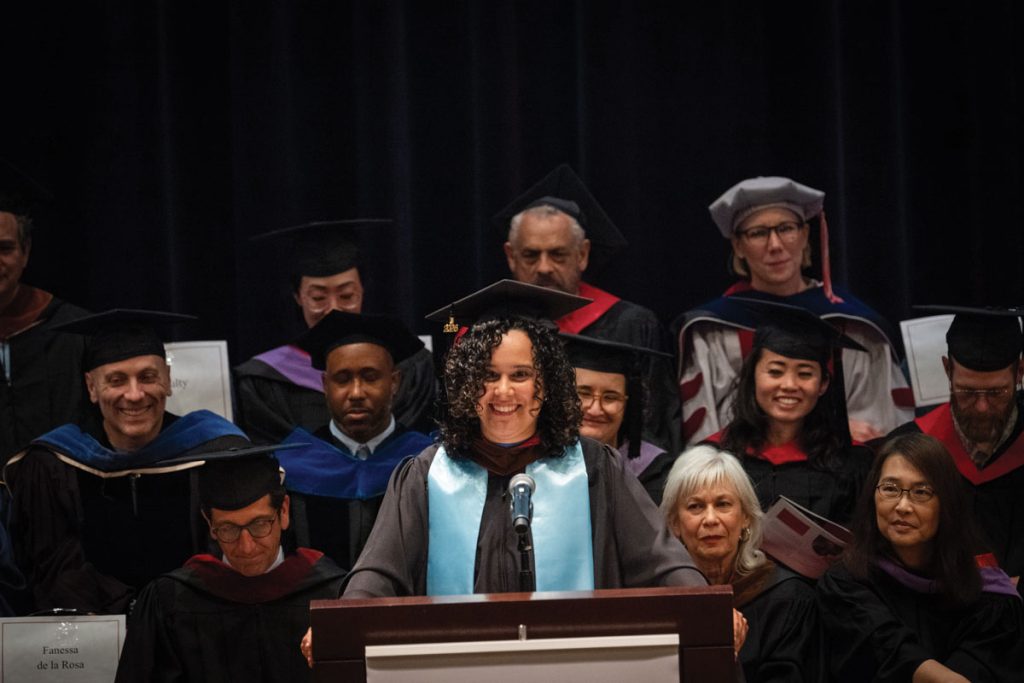
Fanessa de la Rosa ’19 addresses fellow graduates as one of the Commencement speakers at the 2026 Weitzman School of Design at the University of Pennsylvania.
When Fanessa de la Rosa ’19 addressed her fellow students at their graduation from the Weitzman School of Design at the University of Pennsylvania in May, her message was simple: embrace the unknown.
“We don’t know what the future holds, especially in our cities in this political environment,” de la Rosa says. “Hopefully, we’ve given ourselves the skills to be able to tackle the challenges that we can’t foresee.”
“Every chapter has a purpose, even if it is currently unknown, and every challenge has pushed me to recognize that I have the tools to bring my vision to reality, because I can build with and learn from others,” de la Rosa continued in her speech.
De la Rosa earned her master’s in city planning with a concentration in housing, community, and economic development after receiving the Moelis Scholarship, one of Penn’s most prestigious full-tuition awards, and left the ceremony with the Paul Davidoff Award for excellent work in her concentration.
“I grew up in a strong, interconnected community in New York City, so I always participated in community events at church and in school,” she explains. “I didn’t know where it would lead me, but I knew I wanted to support communities. I was always interested in how community empowerment works and how agency can be returned to community members. To me, urban planning at its core is about bringing back a vision of community empowerment, helping them build the tools to shape their own growth. Even while at Lafayette, I think I was naturally asking planning-specific questions, but I didn’t have the language for until later in my education.”
After graduating from Lafayette, de la Rosa worked for a real estate developer focusing on affordable housing projects and for the Bronx’s Fordham Road Business Improvement District as a commercial revitalization program manager. There, she focused on coalition building, placemaking, and resource building for small businesses and the broader commercial corridor.
“I came back to get my master’s because I wanted more of a foundation in planning, and I came back to another program in Pennsylvania because I wanted an understanding of another city rather than remaining a lifetime New Yorker,” de la Rosa says.
Because de la Rosa’s program falls under the Weitzman School of Design, her coursework included several studio courses — the equivalent of semester-long capstone projects. She honed her development skills by reenvisioning the revitalization of a commercial corridor in Cleveland, Ohio.
“I learned how to do a lot of spatial analysis and economic analysis, but always contextualizing it in the lens of the communities,” she says. “My studies left me more curious about how cities globally address climate challenges through planning, design, and financing. I also traveled to China in partnership with a local university there to study how rural areas can become more resilient amidst rapid urbanization.”
Throughout her time at Penn, she worked with local Philadelphia nonprofits, particularly those benefiting the city’s large immigrant community, and conducted research funded by the Kauffman Foundation studying the agglomeration of Black entrepreneurs in Philadelphia and beyond. Drawing on the support network she found as a Posse Scholar at Lafayette, de la Rosa also worked alongside classmates to create Raices, Weitzman’s first Latinx Student Association.
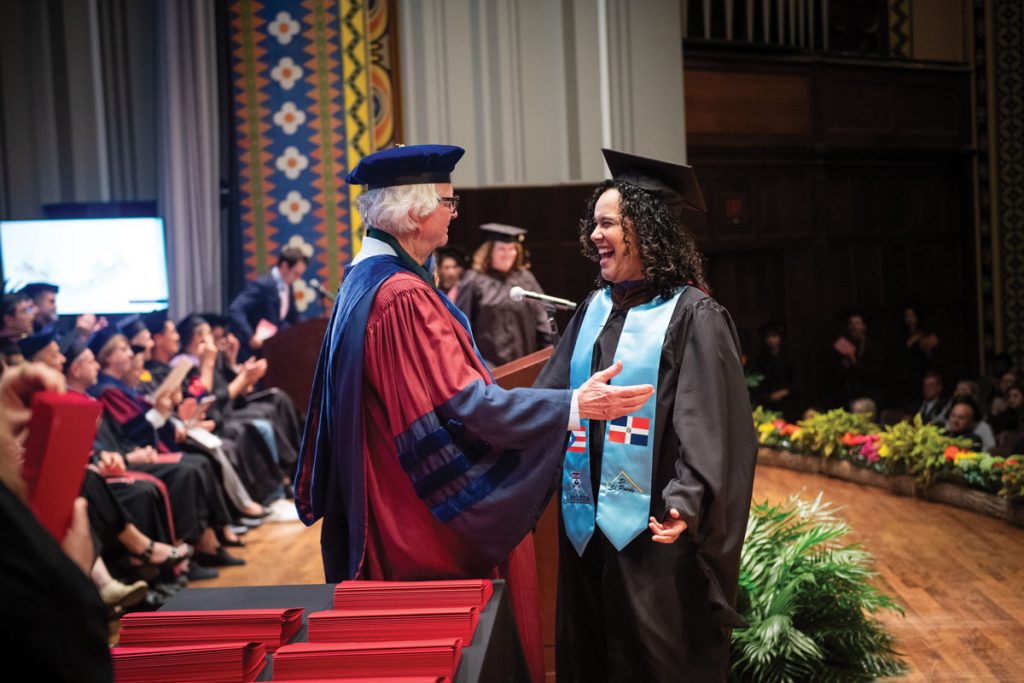
De la Rosa greets the dean of the Weitzman School of Design during Commencement.
“My upbringing and Posse taught me that wherever I go, I go even farther in community, and that really shaped my undergrad experience and how I expect to build spaces for myself,” de la Rosa says.
De la Rosa first traveled internationally while pursuing engineering studies and international affairs at Lafayette and saw the different ways that cities could function; de la Rosa was a member of the inaugural interim trip to Senegal with Wendy Wilson-Fall, professor and chair of Africana studies, and also traveled to Madagascar with the Lafayette Initiative for Malagasy Education (LIME). She remains involved at Lafayette through the Gateway Career Center, regularly speaking with students and participating in programming to pay forward the guidance she received from Gateway staff, especially former senior associate director and coordinator for Access, Equity, and Inclusion Initiatives Alana Klass.
“Lafayette encouraged me to lead with my interests, even if I didn’t know what the next step would look like,” de la Rosa says. “I’m interested in doing international development work, and these programs were the first time I could see what it would look like to pursue that. It gave me a global perspective I wouldn’t otherwise have.”
She is putting that global perspective to use in her next role — a six-month internship in the finance and planning department of United Nations-Habitat in Nairobi, Kenya, focused specifically on improving municipal financing systems.
“I’ll be working on addressing financing challenges that are foundational to ensuring cities in the Global South respond effectively to the needs and growth of neighborhoods,” she explains.
“Observing cities unlike our own and getting a glimpse of how people build community there really gave me the tools to know I wanted to return and dive deeper.