From chemistry to poetry
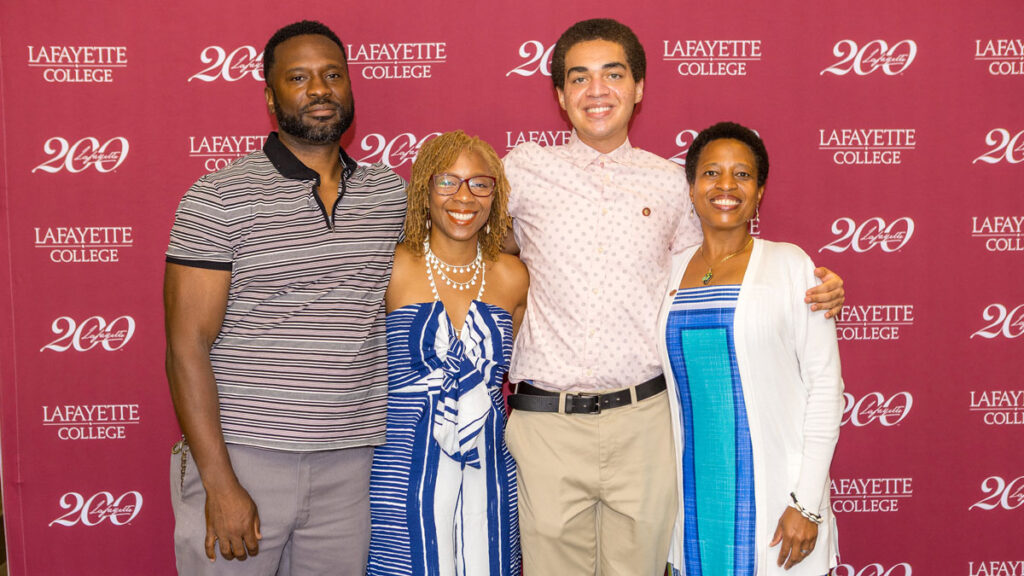
From left: Alvin P. Lyte ’03, Dr. Nkechi E. Mbadugha ’03, Kees M. M. Keiper ’29, and Dr. Bessie N. A. Mbadugha ’96, P’29 at the 2025 Legacy Brunch.
By Madeline Marriott ’24
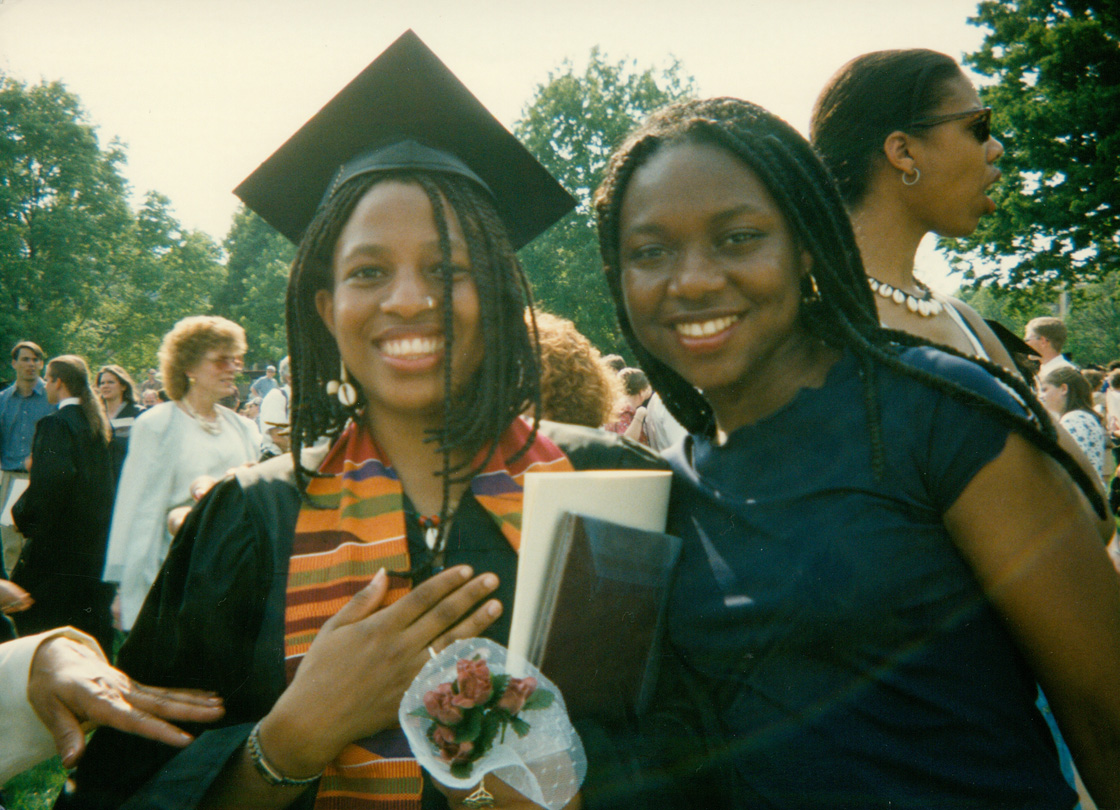
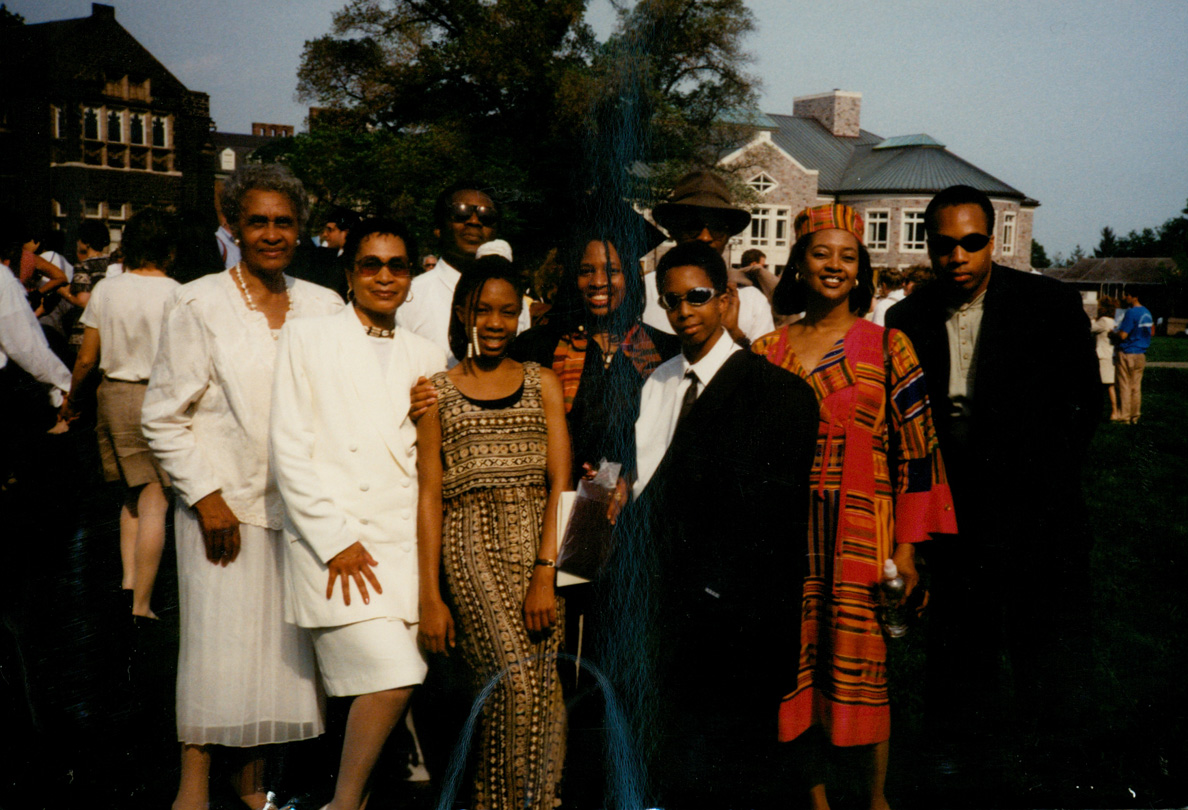
The career path of Bessie Mbadugha ’96 P’29 has been anything but linear.
From the beginning, she pursued her divergent interests, studying both chemistry and English at Lafayette.
“People were definitely puzzled, wondering why I was doing both, but I know each discipline strengthened the other,” she says. “My English helped my chemistry because I did so much writing while publishing as a researcher, and my chemistry helped my English because I could approach writing and the construction of sentences with my analytical brain. I loved having my foot in both worlds.”
After graduation, she spent a year as a research scientist for McNeil Specialty Products, working on product development for Splenda before its U.S. approval.
“I was baking—measuring things out by the gram, conducting taste tests, and analyzing organoleptic panels,” she explains. “It was a fascinating job. I loved my brush with food science.”
From there, she went on to Emory University to earn her Ph.D. in chemistry before conducting postdoctoral drug discovery research at Northwestern University.
“I lived in Nigeria until I was 10, and I got to see how traditional remedies worked,” she explains. “My father got very sick and was diagnosed with diabetes, and when he came home from the hospital, he was still very weak and not himself. We had a family friend, Chief Ezemama, who gave him this really gross-looking concoction—I remember bringing it to him from the fridge and shaking it up—and then he got well. I was like, ‘What is that? And why did it work?’”
This experience inspired her interest in drug discovery. At Northwestern, she worked in the lab of Richard Silverman, who had just discovered Lyrica, a now widely used drug for epilepsy, fibromyalgia, and nerve pain.
“It was a joint appointment with the medical school at Northwestern, and it was really an eye-opener to see what goes on when a drug is discovered, manufactured, and tested,” she says.
She then began a tenure track professorship at St. Mary’s College of Maryland, where she conducted research with students, taught organic chemistry and an advanced drug discovery course, and applied her humanities background to teach a course for non-majors.
“I had students read and respond to journal articles and write short stories with a scientific component to them,” Mbadugha says. “I wanted to show them that the topics are accessible and that there was no need to run and hide from science.”
When her family relocated to North Carolina, she took a teaching position at UNC Chapel Hill— her first foray into classes of that size.
“I was teaching organic chemistry in an auditorium to over 200 students at a time,” she says. “I took a really interactive approach to teaching, had open office hours, and was still able to form those connections with students. My favorite part was seeing them go on to do such wonderful things, becoming doctors and dentists and researchers. I had Black female students at both schools tell me that having me as a professor was an inspiration to them, which was an incredible feeling.”
Mbadugha then took a hiatus from academia to focus on her young family, and became highly involved in the community through the Hillsborough Chamber of Commerce and the Board of Directors at The Expedition School.
“My first thought when I see something new is always that maybe I could help,” she says. “I jump in head first, and that leads to another thing, which leads to another thing, and I love the flexibility of being able to do that.”
After relocating back to the Chicago area in 2019, she again found a role at the intersection of her passions for writing and science, this time as a grant writer for STEM School Evanston, a non-profit organization working to bring a school to the 5th ward in Evanston.
“It’s a traditionally Black community, and during the desegregation era, they closed the community school and were busing students all over the city,” she explains. “A huge movement has been going on for decades to get a school in that neighborhood again, and our efforts were actually successful—the school is currently being built.”
The school is scheduled to open in fall 2026. Mbadugha worked on grants that funded a feasibility study and other surveys to amplify local Black voices throughout the process.
Now, in addition to homeschooling her youngest child and staying connected to the college as the chair of the Mid and Intermountain West Advisory Council, Mbadugha is currently getting back to her literary roots, this time in service of her own creative writing career.
“My mother was a poet, and one of the things I inherited from her is all of her journals and work on her laptop. We had always gone back and forth as each other’s editors,” she explains. “I felt if I could look through her work, it would feel like she was still here, because I’d still be writing with her. I started my current project, continuing her stories and responding to her poems, when I was a Craigardan artist-in-residence for literary arts in summer 2024, and plan to publish a collection of short stories and poems with her.”
Mbadugha’s son, Kees ’29, is currently a first-year student at Lafayette, majoring in English, with an undecided second major.
“Kees received several excellent admissions offers, but Lafayette emerged as his favorite,” says Mbadugha. “My sister Nkechi Mbadugha ’03 is an alumna, as is her husband, Alvin Lyte ’03. We were fortunate to experience a full circle, family moment while attending the 2025 Legacy Brunch.”